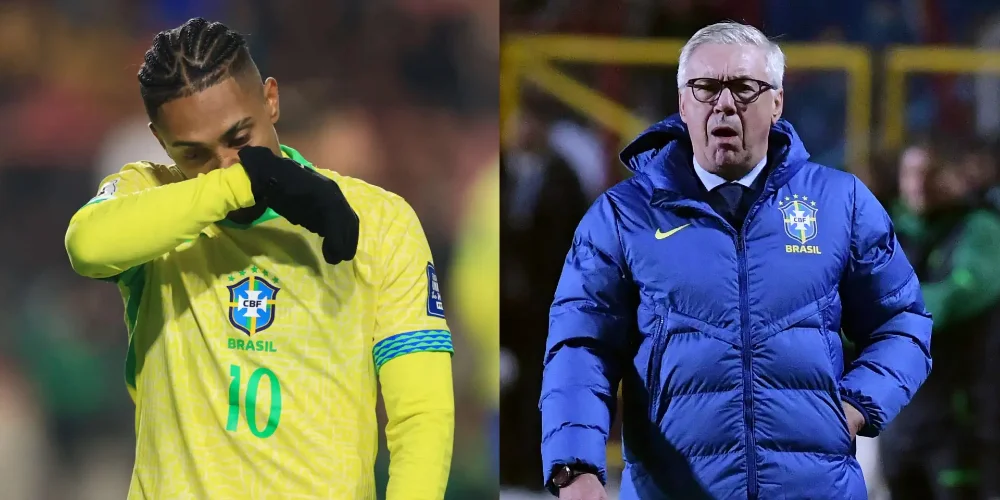
Raphinha’s latest injury scare while on international duty with Brazil has reopened an old question in football: how much responsibility should national-team coaches carry for protecting players who are also vital to their clubs?
The Barcelona forward was withdrawn at half-time during Brazil’s 4-2 friendly victory over Australia after experiencing discomfort in his right thigh. Subsequent medical examinations found a small muscular swelling, and the Brazilian Football Confederation released him from the squad as a precaution.
The incident has naturally raised concerns in Barcelona, particularly because Raphinha remains an important part of the club's plans. But the wider debate surrounding Carlo Ancelotti's handling of the player requires more than simply looking at the timing of the injury.
What happened to Raphinha with Brazil?
Raphinha started Brazil's friendly against Australia and scored from the penalty spot before being replaced at the interval.
Brazil eventually won the match 4-2, but the forward's early departure quickly became one of the main talking points. On September 30, the CBF confirmed that medical imaging had detected a small muscular edema in the posterior area of his right thigh.
The federation decided not to risk the player further and released him from international duty. Brazil will therefore face India without Raphinha, with no replacement called into the squad.
For Barcelona, the immediate concern is understandably his recovery and availability for the club's upcoming fixtures.
Why Ancelotti has come under scrutiny
Ancelotti is now responsible for Brazil rather than any individual European club. His job during an international window is to prepare the national team, assess his players and compete in the matches scheduled by the federation.
That creates an unavoidable conflict with the interests of clubs.
Barcelona may have every reason to want Raphinha protected, especially given his importance to the squad. Brazil, however, also has sporting objectives and expects its leading players to be available when they are selected.
The difficult question is where the responsibility begins and ends for a national-team coach when a player has a demanding club schedule.
An injury occurring during international duty does not, by itself, establish that a coach made a reckless decision. Players can suffer injuries in training, league matches, friendly games or even during routine preparation.
At the same time, clubs have legitimate reasons to monitor the physical condition of their players, particularly when international travel and a crowded calendar are involved.
The national team has its own priorities
The club-versus-country debate often becomes especially intense when a prominent player is injured while representing his nation.
From the club's perspective, the player is a crucial asset whose fitness affects an entire season. From the national team's perspective, that same footballer is one of the players selected to represent the country.
The two interests do not always align.
A national-team coach cannot realistically manage every player's workload according to the fixture list of his club. International windows are limited opportunities for coaches to bring their squads together, work on tactics and build relationships between players.
That is why the argument that a national coach should automatically protect a player for his club is difficult to apply consistently.
The same issue could arise with any major international star, regardless of whether he plays for Barcelona, Real Madrid, Manchester City or another leading European club.
Thomas Tuchel offers another perspective
The debate has also emerged elsewhere during the current international period.
England manager Thomas Tuchel recently rejected the idea that Premier League managers should influence how their players are used by the national team. Speaking about England's demanding Nations League schedule, Tuchel said he does not take calls from club managers about player minutes.
He argued that national teams cannot simply treat international matches as optional or allow players to reduce their involvement because of their club commitments.
Tuchel's comments underline the fundamental problem: clubs and national teams have different responsibilities, even though they depend on the same players.
The England manager's position does not settle the Raphinha debate, but it illustrates why the issue is more complicated than simply blaming one coach for an injury.
Raphinha's situation needs to be separated from speculation
The most important confirmed information at this stage is medical.
Brazil's federation reported a small muscular edema in Raphinha's right thigh and said he was released as a precaution.
Beyond those facts, conclusions about intent require caution.
It is possible to question whether a player should have been used, whether his workload was appropriate or whether another decision could have reduced the risk. Those are legitimate football discussions.
But an injury does not automatically prove that a coach ignored the player's condition or deliberately exposed him to unnecessary danger.
The distinction matters because football discussions can quickly move from confirmed information to assumptions about what a coach supposedly intended.
The bigger club vs country problem
Raphinha's case is another reminder of the tension built into modern football.
Clubs pay players' salaries and depend on them throughout long domestic and European campaigns. National teams, meanwhile, have access to those same players only during limited international windows.
Neither side can completely ignore the interests of the other.
For players, representing their country can also carry a significance that cannot be measured purely through club workload. International football remains one of the defining parts of many careers, and players often want to compete rather than simply preserve themselves for their next club match.
The challenge is finding a balance between competitive demands and responsible player management.
What happens next for Raphinha?
For now, the priority is Raphinha's recovery.
Brazil has released him from the squad after the medical examination, meaning he will not take part in the upcoming friendly against India. The CBF said the decision was taken as a precaution with the aim of allowing him to recover promptly.
Barcelona will now monitor his condition and assess when he can safely return to action.
The incident may continue to fuel debate about Ancelotti's decisions, but the available evidence currently establishes an injury and a precautionary withdrawal—not the intentions that some observers may attribute to the Brazil coach.
In the end, the Raphinha episode illustrates one of football's oldest tensions in a modern form: a player can be indispensable to both his club and his country, while the interests of the two teams do not always point in the same direction.
Comments (0)
No comments yet. Be the first to share your thoughts!
Leave a Reply
Note: Links and URLs are strictly not allowed. All comments are reviewed before publishing.